You want your loved one to finish a program that treats the substance use and the mental health condition together, and then to come home with a plan that holds. This guide shows what to expect in co-occurring disorder IOP in Tucson by walking through the program at Recovery In Motion, from the first phone call through week eight, including two requirements that come before the first group: at least 30 days substance free and no use in the last 72 hours. Knowing those up front, and what each week asks of the person you love, turns a frightening unknown into steps you can actually follow.
The short answer: A co-occurring disorder IOP (intensive outpatient program) addresses a substance use disorder and a mental health condition, such as anxiety, depression, PTSD, or bipolar disorder, in the same weekly plan. At Recovery In Motion in Tucson, that means group every weekday morning, weekly one-on-one therapy, and weekly case management, while your loved one lives at home or in sober living.
How many hours, and for how many weeks? Groups run 3.5 hours a day within an 8am to 12pm block, Monday through Friday. That comes to about 17.5 hours of group a week, plus individual therapy, case management, and six 12-step meetings. Length of stay varies from person to person. The treatment team decides together when someone may be ready to step down, and progress is tracked in small milestones along the way.
That fear you carry from the last time makes sense, and it is the reason this guide spends so much time on structure: what happens each morning, who checks in, and what happens if something goes wrong. People are more than a diagnosis, and so is the person you love. A good program treats them that way from the first call.
What to Expect in Co-Occurring Disorder IOP in Tucson: What Do You Need Before Starting?
Before starting IOP at Recovery In Motion, your loved one needs at least 30 days substance free, no use in the last 72 hours, and no current suicidal thinking. They also cannot have medical or mental health needs that call for a higher level of care. IOP comes after detox and usually after a 30-day residential program, so it is not the place to start.
Many people who enter the Recovery In Motion IOP have been in treatment before. Many arrive straight from partner residential programs in the Tucson area, and those programs account for more than half of recent clients. Others come from detox facilities, from home health organizations, or directly from incarceration. Some have been asked to leave other programs. The team considers them too, because without an opportunity, there is no chance at recovery.
Recovery In Motion does not provide detox. If someone is actively withdrawing or has used in the last 72 hours, they are not admitted. Withdrawal is checked with a COWS score (the Clinical Opiate Withdrawal Scale). That is not a dead end, though. The admissions team refers the person to a local detox partner and connects with that facility’s case managers, so the person can return for IOP once they are ready.
Here is how that can play out. One caller, described here without identifying details, had been relapsing on alcohol for a whole week. During the pre-assessment, the question was asked point blank: when was your last use? The answer was earlier that same morning, so the pre-assessment stopped, and the caller was referred to detox, which is a higher level of care. Alcohol withdrawal can be medically dangerous, so if your loved one drinks heavily, talk to a doctor or a medical detox program before they stop.
The clinical team also screens for needs the program cannot safely meet. These include medical needs like wheelchairs or walkers, and mental health needs that call for more support than IOP can give. People who keep relapsing repeatedly usually need detox or residential care first, because IOP with supportive housing is generally not enough structure for that stage. SAMHSA recommends integrated care that addresses mental health and substance use together, and that approach depends on a setting that fits the person. This table shows where IOP sits.
| Residential care | Co-occurring IOP at Recovery In Motion | Outpatient (OP) at Recovery In Motion | |
|---|---|---|---|
| Where the person lives | At the treatment facility | At home or in affiliate sober living | At home |
| Weekly time | Around the clock | Monday to Friday, 3.5 hours of group a day, plus weekly 1:1 therapy and case management | Group 1 to 3 days a week, 1 to 3 hours a day |
| Usually fits someone who | Recently used, keeps relapsing, or needs 24-hour support | Has 30+ days substance free and is stable enough to live outside a facility | Has built skills in IOP and may need lighter support |
| Where it happens | At partner residential programs | Recovery In Motion, Tucson | Recovery In Motion, Tucson |
What you walk away with: a clearer sense of whether IOP may be the right next step now, or whether detox or residential care may need to come first.
Step 1: How Do the Benefits Check and Pre-Assessment Work?
Once you know IOP might fit, the first real step is a phone call. A biller checks your loved one’s insurance benefits, your loved one completes a pre-assessment, and the clinical team approves or denies admission. The admission specialist calls back the same day with the answer.
The call starts simply. Admissions asks who you are and what your loved one is struggling with. Then they ask about insurance and take a name and date of birth to look up the plan. Recovery In Motion is in-network with Banner Health, Blue Cross Blue Shield, and Molina. For AHCCCS (Arizona Medicaid), clients are typically covered at 100%. If your loved one’s plan is not one the program takes, staff look for local resources that do accept it, so you do not leave the call empty-handed. The federal Mental Health Parity and Addiction Equity Act also limits how much many health plans can restrict mental health and substance use benefits compared with medical benefits.
One more thing families often ask about is whether the type of insurance changes the care. It does not. Private insurance and Medicaid clients receive the same treatment, with no extra and no less for anyone. That is what dignity and respect look like in practice.
If you are calling at 2am for someone else, know this up front: the admission team needs to speak with your loved one directly and see if they are willing to do the pre-assessment. That can feel frustrating when you are scared. Still, it means your loved one has a say in their own care from the very first conversation, which is part of meeting clients where they are. Admission is not guaranteed, and the clinical team makes the call based on the requirements above.
What you walk away with: a same-day answer on admission and a clear start path, before anyone packs a bag.
Step 2: What Happens on Day One Before Group Begins?
After approval comes day one. Your loved one completes admission paperwork and a biopsychosocial assessment with a behavioral health technician, and group starts the next morning. Any previous diagnoses are shared with clinical and medical staff and checked again for accuracy.
A biopsychosocial assessment looks at the whole person: physical health, mental health history, substance use, family, housing, and work. For a family member, this matters because it is the first moment the program sees your loved one as more than the reason they were referred. Substance use is often connected to other concerns. For some people it may be linked to something underneath, and day one is where the team starts looking.
Re-checking old diagnoses is not a formality. The team looks at medication compliance, current symptoms, and how pervasive and persistent those symptoms are. Federal guidance on substance use disorder treatment for people with co-occurring disorders notes that substance use can produce symptoms that look like a separate mental health condition, which is why timing matters.
Here is one example, shared without identifying details. A person arrived with a nearly ten-year-old diagnosis of schizoaffective disorder. The clinical team and medical provider reassessed it and found the person had never been off methamphetamine long enough to rule out substance-induced symptoms. They worked on stabilizing the person first. After some time in treatment, the symptoms tied to that diagnosis stopped for this individual. The person was then supported with basic mental health interventions, including extended therapy and health home support, rather than a higher level of care and a medication.
That is one person’s experience, not a typical result. Many diagnoses are confirmed on review, and when they are, the team follows up on medication and any outside professional support. The point is that diagnoses get a second look.
What you walk away with: a current picture of what is going on, which shapes what happens in group the next morning.
Step 3: What Does a Typical IOP Week Look Like?
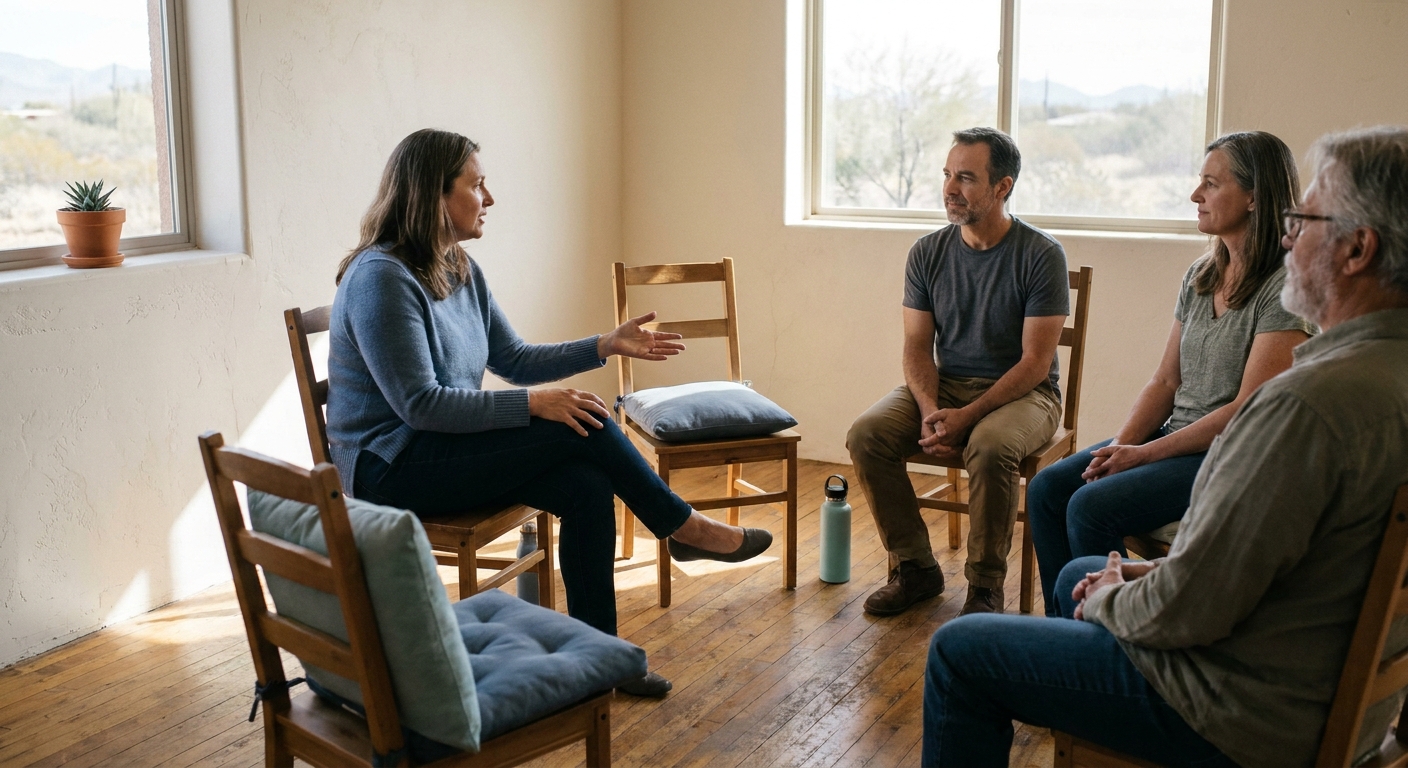
This is the heart of what to expect in co-occurring disorder IOP in Tucson. A typical week at Recovery In Motion runs Monday through Friday, 8am to 12pm, with 3.5 hours of group each day. Each week also includes one individual therapy session, one case management appointment, and six 12-step meetings outside group. Substance use and mental health are worked on in the same groups, in the same week.
The groups draw on evidence-based modalities. Here is what your loved one will encounter:
- Cognitive behavioral therapy (CBT): noticing how a thought leads to a feeling and then to an action, like reaching for a drink.
- Dialectical behavior therapy (DBT): skills for handling strong emotions and distress.
- Acceptance and commitment therapy (ACT) and solution-focused interventions: working toward what matters while hard feelings are present.
- Motivational interviewing: a respectful way of meeting clients where they are, including their ambivalence.
- Seeking Safety and trauma-informed care: working on trauma and substance use together, with safety first.
- Mind-body skills in group: slow deep breathing, body scans, and progressive muscle relaxation, which are introduced, demonstrated, and practiced, with yoga and meditation on occasion.
- Physical wellness topics: sleep hygiene, diet, and exercise, taught and discussed (the timing varies by group and facilitator).
- Dual diagnosis care: for anxiety, bipolar disorder, depression, and PTSD at the IOP level.
The mind-body piece has a practical reason behind it. Groups explain the brain chemistry behind addiction, including the fact that the brain does not recover right away. That can help your loved one understand why they may feel unmotivated, anxious, or depressed, or have intense cravings, even after stopping entirely. Cravings are often a response to an emotion or a stressor, so a breathing skill practiced in group on Tuesday is a skill your loved one may choose to use at the sober living house on Saturday night.
How Monday, Wednesday, Friday differ from Tuesday and Thursday
The week alternates between two kinds of days. Here is the sequence:
- Monday: one hour of process group, one hour of check-in group, and 1.5 hours of psychoeducation.
- Tuesday: 2.5 hours of psychoeducation across two separate groups with different facilitators, plus one hour of check-in group.
- Wednesday: process group, check-in group, and psychoeducation, the same split as Monday.
- Thursday: two psychoeducation groups and a check-in group, the same split as Tuesday.
- Friday: process group, check-in group, and psychoeducation, which closes out the week.
- During the week: one 1:1 therapy appointment and one case management appointment.
- Across the week: six 12-step meetings outside group hours.
Process group is where people talk through what is actually happening in their lives, while psychoeducation teaches skills and information. Check-in groups happen every day, so nobody goes more than a day without someone asking how they are really doing. Having two facilitators on Tuesday and Thursday also means your loved one hears more than one voice and more than one way to explain an idea.
Later on, clients can step down from five days a week to three days a week to fit a work schedule. That works out to about 10.5 hours of group a week, which offers your loved one a way to return to work while continuing to have support.
What you walk away with: a predictable rhythm, so your loved one knows where they will be at 8am tomorrow.
Step 4: How Is Integrated Care Tracked Week by Week?
A schedule only helps if someone is paying attention to how the person is actually doing. At Recovery In Motion, integrated care is tracked by watching triggers, cravings, and new habits week by week, while trauma and depression are worked on inside a relapse prevention plan. The aim is to support your loved one in staying substance free while the deeper pain is addressed, not after.
Here is why the order matters. Once substances are removed, depression or trauma can come to the surface more strongly. Sometimes those feelings are so intense that a person goes back to using just to feel better. So the team listens closely to how your loved one describes their feelings, their routine, and where they believe the trauma and depression began. Step one is naming triggers: a specific feeling, a smell, a dream, or a circumstance in their day that pulls them toward old decisions. The same federal guidance on co-occurring disorders supports this kind of combined plan, where both conditions are addressed together.
Progress is measured in small, concrete steps. Here is one example of how one person’s milestones were tracked:
- Week 1: they described feeling lost.
- Week 2: they could name two moments when they did not feel as lost, and they explored why.
- Week 4: they named action steps they were taking and where they wanted to go next.
- Week 8: they had at least three basic steps for each objective related to cravings. They tracked how often cravings happened, what they used to cope with the thoughts, and how they handled the physical feelings, including planning ahead for traumatic dates and events.
That shows how progress is tracked for one individual. Each person moves at their own pace.
Rapport matters too. In one case, shared without identifying details, a person kept saying they were “just tired.” The team did not stop there. Once trust was built, the person shared that they were having frequent panic symptoms. The plan then shifted from stress management to panic-focused work: finding triggers, tracking avoidance, and practicing coping strategies. Life also does not pause for treatment. A couple of clients have lost close family members while in care, and staff worked with them as they grieved while working to stay sober.
What you walk away with: a tracked plan that connects the mental health work to the substance use work, so neither is left out.
Step 5: What Rules and Supports Surround the Groups?
Around the groups sits a layer of structure that families often do not expect: affiliate sober living, six 12-step meetings a week, regular drug testing, a clear response to a positive test, MAT for those who need it, and case management for life skills and work.
Clients start in an affiliate sober living house. For the first two weeks, they cannot go out without house staff. This keeps the focus on themselves, so outside distractions are less likely to pull them back into old habits. Sober living is billed separately from the program, and the admissions team can walk you through that on the call. Many people leave residential care with no income and nowhere stable to go. A housing setback isn’t the same thing as a recovery setback, and stable housing can give your loved one room to focus on recovery before looking for work.
Drug testing starts twice a week and drops to once a week after 30 days of negative tests. After a positive test, testing goes up to three times a week, and the person then needs 30 negative days before it comes back down. They also sign a behavioral contract agreeing to follow all program rules. If they test positive one more time, they are transferred to a higher level of care, sometimes back to a partner residential program for monitoring and stability, and they can return to IOP once they finish. This is not punishment. It is a plan agreed to ahead of time, so a slip is met with more support instead of silence.
For medication, Recovery In Motion offers MAT to people enrolled in IOP or outpatient services. NIDA lists buprenorphine and naltrexone among the medications used to treat opioid use disorder. Many clients arrive already on Suboxone. The provider usually meets them within 72 hours, takes a full history and physical, and writes a two-week Suboxone prescription that is picked up at a pharmacy. Sublocade and Vivitrol injections are given on site, usually once a month as prescribed. Sublocade needs a prior authorization that takes two to three weeks, and the person stays on Suboxone until it arrives.
Case management covers vital documents, budgeting, grocery shopping, cooking, and job support. Employment readiness is not assessed until the fourth week of case management, so the first month stays focused on stability.
What you walk away with: a clear picture of the guardrails, and of what happens if your loved one slips.
How Can Family Members Help During IOP?
You can help by staying supportive and staying curious about your loved one’s treatment. Ask what they worked on in group, what triggers they are naming, and what their plan is for the hard days.
Many families come in carrying a worry they do not say out loud: that their loved one will be punished for being “bad,” or that they are too far gone for treatment. That is one of the biggest misconceptions in this community. Recovery In Motion works with co-occurring disorders that some facilities turn away. Most of the staff are in recovery themselves, and they have been through things similar to what your loved one is facing. That shared experience can help them relate, and it may help your loved one feel that the people in the room understand.
One client, shared without identifying details, came in using methamphetamine and kept calling himself “just another addict.” The conversations that followed took the label out of it. He was not just an addict. He was a person with an addiction who needed the environment and the time to work on recovery, with people who had walked a similar road.
Sometimes the hardest part is getting someone to the door at all. One caller, an adult son, reached out because his mother was living on the street with a severe substance use disorder, and he did not know what to do. The first goal was to get her to a safe location where she felt comfortable: his house, a family member’s place, anywhere she would be willing to talk. In the most non-judgmental way, he was pointed toward intervention resources and walked through detox options covered by insurance. It is about meeting your loved one where they are, with dignity and respect.
If treatment has not worked before, a useful question is “What exactly is different this time, and can I see it?” Daily check-ins, testing, sober living, and tracked milestones are things you can actually see.
What Do Families Ask Most Before the First Group?
Before the first group, families usually ask about hours, recent use, mental health care, testing, insurance, and medication. Here are direct answers to each.
How many hours a week is a co-occurring IOP in Tucson?
Groups run Monday to Friday within 8am to 12pm, 3.5 hours a day, with weekly 1:1 therapy and case management. A step down to three days a week may fit a work schedule.
Can someone start IOP if they used in the last few days?
No. The program requires no use in the last 72 hours and at least 30 days substance free. The person is referred to a local detox partner and can return for IOP afterward.
Will anxiety, depression, or PTSD be addressed along with substance use?
Yes. Both are addressed in the same week through CBT, DBT, ACT, motivational interviewing, and Seeking Safety, as part of integrated care.
What happens after a positive drug test in IOP?
Testing rises to three times a week and the person signs a behavioral contract. Another positive test means transfer to a higher level of care.
Does insurance pay for IOP at Recovery In Motion?
Recovery In Motion is in-network with Banner Health, Blue Cross Blue Shield, and Molina, accepts TRICARE, and works with AHCCCS, where clients are typically covered at 100%. The benefits check is the first step on the call.
Is medication available during IOP?
Yes. MAT with Suboxone, Sublocade, or Vivitrol is available, and the provider usually meets clients within 72 hours.
What Can You Expect, and What Is Your Next Step?
IOP at Recovery In Motion aims to offer your loved one a clear start path, coping skills, and a relapse prevention plan that covers both their mental health and their substance use. Recovery looks different for every person.
When you think about what to expect in co-occurring disorder IOP in Tucson, one thing you can look for is progress you can ask about. Before someone steps down to a less intensive level, the team looks for more than memorized answers. They want to see your loved one explain how what they learned in group connects to their own relapse prevention plan. They check whether what the person writes in their journal and says in treatment planning lines up, and they watch for someone who starts taking steps on their own. The treatment team makes the step-down decision together, not one person on a hunch.
If your loved one is in crisis right now, do not wait for a callback. For help finding detox or other treatment, call the SAMHSA National Helpline at 1-800-662-4357. If they are having thoughts of suicide, call or text 988. If there is immediate danger, call 911.
When you are ready, call Recovery In Motion in Tucson, AZ or visit recoveryinmotion.com to start the benefits check and pre-assessment, and get a same-day callback on your start path. Before you dial, find out one thing: the date of your loved one’s last use. It tells the team a great deal about the right level of care, and it is a practical first step toward turning this unknown into a plan.
Ready to Take the First Step in Tucson?
Wondering if an intensive outpatient program can really address both substance use and mental health at the same time is a fair question, and you do not need to have it all figured out before you ask. The team at Recovery In Motion can walk you through how integrated care works week by week and what it might look like for you or someone you love. Reaching out is simply a conversation, and the next step is as easy as calling the office.
Individual experiences and outcomes vary.